Showing posts with label Reading Log. Show all posts

Wednesday, May 23, 2012

The God Emporer of Dune

Another in a long line of Frank Herbert books The God Emporer of Dune is the chronicle of a time three thousand years after Paul took the Imperial throne. Paul is not very involved in the story as he has evolved into something other than human, controlling the universe from his spice gas chambers. His decedent Leto Atredies is the presiding lord of Arrakis, a world that has been transformed from a barren wasteland to a lush tropical paradise. The book follows a band of smugglers, one of which is apparently a descendant of Paul, and the rightfull heir to the Arrakan throne as well, as they try to supplant Leto despite his tyrannical hold on the planet. Their struggle is similar to Paul's in the first Dune book, as they are exiled individuals of enormous potential power, who are hunted by a despotic force.

Monday, May 14, 2012

Foundation Trilogy: Book 2

Reading the second book of the Foundation Trilogy, I noticed a change in Asimov's writing style. Rather than follow a detached story line which is based around the planet Terminus, book two follows actual characters and develops them to progress the story line. The First part relates the story of the Mule, the dictator of the galaxy who uses mind control to re-enforce his power, as he hunts, and is hunted by the Second Foundation, that Hari Seldon created. This story is different from other Asimov books I've read, it focuses on the characters and operates almost as a physiological thrill, for only at the end of the first half do we figure out who has maneuvered whom. The second half focuses on a little girl in the center of a conspiracy by the telepaths of the second foundation. While this story is a necessary part of the Foundation universe, it was a disappointment.

Wednesday, May 2, 2012

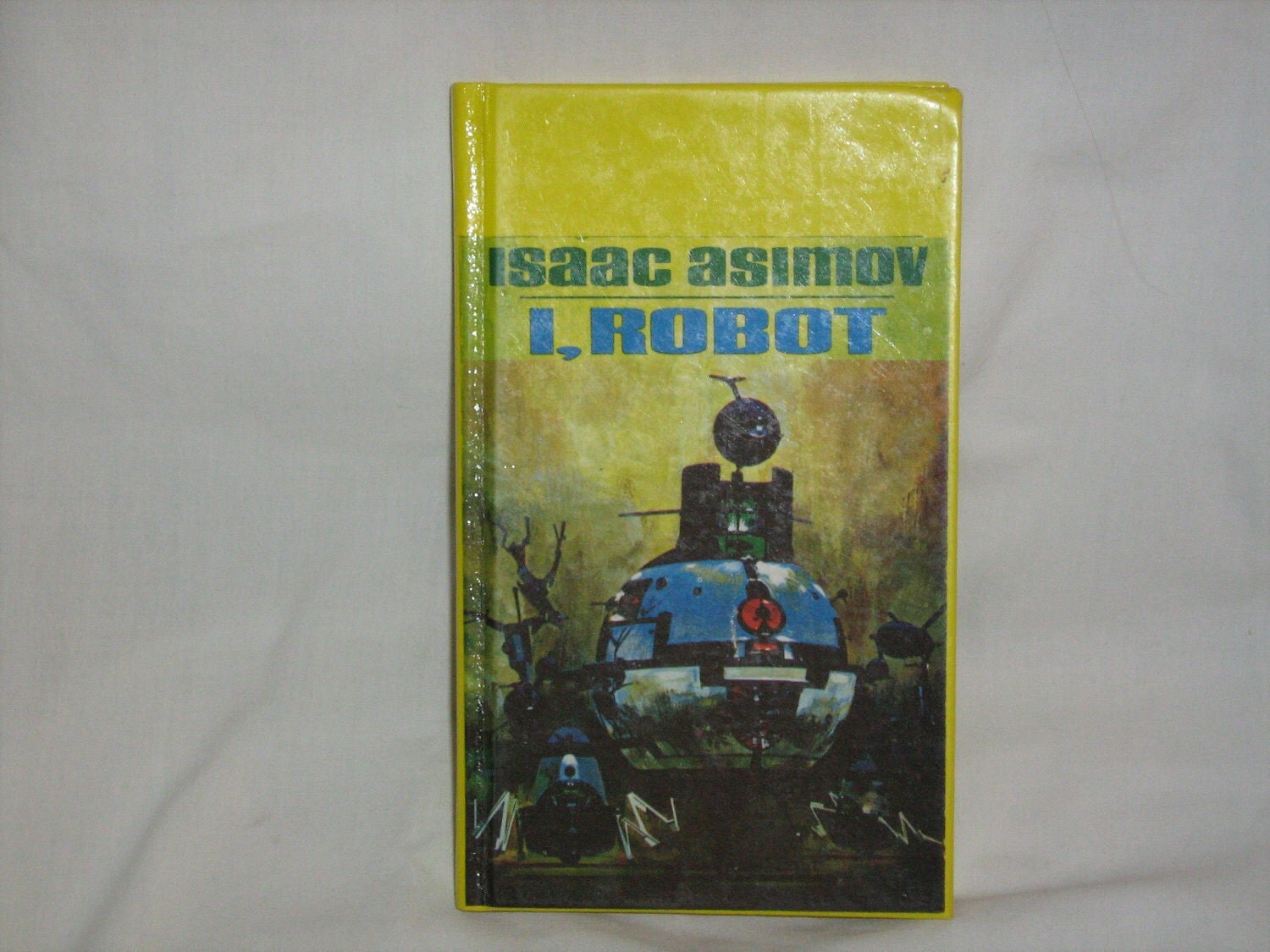
I, Robot


I'm reading I, Robot by Issac Asimov. This book is not that long (like 200 pages) and maintains a middle diction throughout. Asimov skips from story to story, but holds the book together with the narrator Dr. Susan Calvin, the aging chief robopsychologist of U.S. Robotics and Mechanical Men. This format is similar to Asimov's Foundation Trilogy, where the story line skips forward time, sometimes by hundreds of years, but is always based around the planet Terminus and it's Foundation. In spite its brevity, I, Robot accomplishes far more through commentary on the social issues of Asimov's time, and in the abstraction of a potential future scenario, than the top sci-fi novels from the past several years combined. The 1940's and 50's, during which I, Robot was written, were a significant time for the advancement of civil rights. Asimov uses robots to symbolize African Americans; by examining the questions "What constitutes sentience?" and "Does sentience necessitate treatment as a human?" , Asimov hopes to convince the reader that the robots of I, Robot are sentient and therefore human (or should be treated as humans). By suggesting that a being, of equal intelligence and value to a human, that is subservient to humans should be considered a human, he attempts to persuade 1950's society to accept african americans as equal to european americans. This abstract social commentary is common in science fiction and is substantially more effective than any amount of marching, occupying, or viral video making because it removes the issues from our reality and places them in a foreign universe where they can be observed objectively.


Friday, April 20, 2012

Dune- Book Trailer


If it doesn't work, here is a link to the version I put on youtube

This is a book trailer I made for Dune


Wednesday, April 4, 2012

Foundation- Asimov

    Isaac Asimov is one of the most prolific writers of the 20th century, producing close to five-hundred stories from 1950 to 1991. His works include I. Robot, the Gods Themselves and countless other best sellers. His Foundation series, which began as a trilogy and was later expanded to contain six books, was the most widely read space epic for decades.
           Foundation, the first book that Asimov wrote in the Foundation series, focuses on the legacy of Harry Seldon, a mathematician who has discovered a way to predict the future. It is a new science that he calls "psycho-history" that involves crowd psychology and certain indexes that represent different aspects of humanity to mathematically predict significant social, political and economic events. When the Galactic Empire collapses, Seldon's Foundation (and its twin on the other side of the galaxy) is the only remaining stronghold of scientific progress.
         Asimov's choice to shy away from a character driven storyline, along with his signature writing style are the just some of the reasons that this book so successful. The sheer immensity of the universe that he creates evokes a childish sense of wonder with each turn of the page, leaving you utterly convinced that a tiny speck on the edge of the galaxy could be so important.

Monday, March 26, 2012

Dune: Lord of the Rings in Space


       Dune by Frank Herbert is the epitome of sci-fi and fantasy. This book brings together aspects of unity, brotherly love, family ties, competition, survival, good and evil and love. From top to bottom and beginning to end, this novel will keep you on the edge of your seat as unpredictable turns in the plot make the story more like a puzzle than a timeline.  Frank Herbert is the Tolkien of Scifi, where Tolkien excels through the grandeur of his environment, Herbert generates that feeling of actually being in his world. Reading Dune, one can taste the spice-laden air, walk the sands as one of the Fremen, and breathe the hot, acrid air of Arrakis. A paragon of an accomplishment in the world of fiction, a true testament to the creativity of man. Herbert is a veritable Titan with a pen, and his work shall long be remembered as a tribute to unparalleled imagination and the power of the written word.

Sunday, March 18, 2012

The Children of Húrin


        Everyone is familiar with J.R.R. Tolkien's  The Hobbit and The Lord of the Rings, and anyone who has read these can sense the passion he has for fantasy. Tolkien spent most of his life writing, rewriting, reorganizing and tinkering with the vast mythology of Middle Earth and the tip of the iceberg is The Simarillion, a collection of epic history, primarily dealing with the fate of the Noldor (a group of elves). In The Simarillion there is a summarized version of the tale of a great hero named Húrin and his kinsman. J.R.R. Tolkien's son Christopher Tolkien published the unabridged version in 2007. In The Children of Húrin, Tolkien departs from the typical fantasy structure where "the truth will out" and good will always conquer evil. This story is tragedy. In The Children of Húrin, Tolkien follows Húrin's son, Túrin, and does a great job of drawing the reader in so they become emotionally invested in the characters and then everyone dies. However, rather than being disappointed, Tolkien ends the story in a way that leaves you thinking that every thing is as it should be.

Monday, March 12, 2012

Reading Requirements

  • Finish a book every other week.
  • Read at least 2000 pages over the quarter
  • Read while falling at 125 mph